.comment-link {margin-left:.6em;}

2Physics

2Physics Quote:
"Many of the molecules found by ROSINA DFMS in the coma of comet 67P are compatible with the idea that comets delivered key molecules for prebiotic chemistry throughout the solar system and in particular to the early Earth increasing drastically the concentration of life-related chemicals by impact on a closed water body. The fact that glycine was most probably formed on dust grains in the presolar stage also makes these molecules somehow universal, which means that what happened in the solar system could probably happen elsewhere in the Universe."
-- Kathrin Altwegg and the ROSINA Team

(Read Full Article: "Glycine, an Amino Acid and Other Prebiotic Molecules in Comet 67P/Churyumov-Gerasimenko"
)

Thursday, October 20, 2005

One Decade of Top Quark
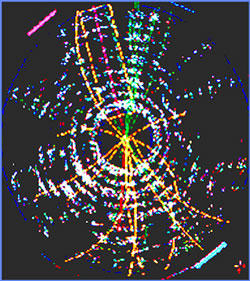
A decade ago in this week, experimental physicists representing seventy-four institutions in Brazil, Canada, Colombia, France, India, Italy, Japan, Korea, Mexico, Russia, Taiwan, and the United States announced the discovery at Fermilab of the top quark, a fundamental building block of matter and the universe.

The name "quark" was taken by Murray Gell-Mann from the book "Finnegan's Wake" by James Joyce. The line "Three quarks for Muster Mark..." appears in the fanciful book. Gell-Mann received the 1969 Nobel Prize for his work in classifying elementary particles. There are 6 different kinds of quark: Up, Down, Charm, Strange, Top and Bottom. Being in a confined state, they act as constituents of fundamental particles like Proton and Neutron but not, for instance, electron. The confinement of quarks implies that we cannot isolate them to measure their masses in a direct way. The masses and their existence must be implied indirectly from scattering experiments. To know more about quarks at your own pace, visit
these pages of hyperphysics.

Fermilab will celebrate 10 years of discovery of Top quark and the new possibilities it opened for science in a half-day symposium entitled "Top Turns Ten" on Friday afternoon, October 21, at Fermilab. The agenda is here.

Labels:


Tuesday, October 04, 2005

Physics Nobel 2005

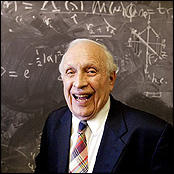
Roy J. Glauber

The Nobel Prize for Physics was awarded to U.S.
scientists Roy J. Glauber and John L. Hall and to
Theodor W. Haensch of Germany for their work
in the field of optics, it was announced Tuesday
in Stockholm. Glauber, 80, of Harvard University
was awarded half the prize money of 10 million
kronor (EUR 1.1 million) "for his contribution to
the quantum theory of optical coherence," the
Royal Swedish Academy of Sciences said.

Glauber's groundbreaking work, reported back in 1963, is in the theoretical
description of the behaviour of light particles. His contributions were
described as "pioneering work in applying quantum physics to optical
phenomena," the Academy said. It added that Glauber had helped explain
"fundamental differences between hot sources of light such as light bulbs,
with a mixture of frequencies and phases, and lasers which give a specific
frequency and phase". Possible implementations of his work on quantum
phenomena include encryption of messages within communication technology.

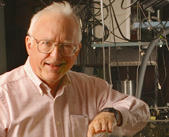
John L. Hall

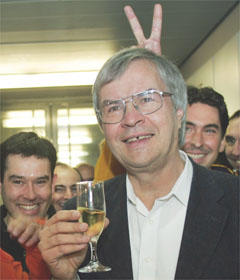
Hall, 71, of Colorado University and Haensch, 63,
of the Max Planck Institute for Quantum Optics
and Munich's Ludwig Maximilian University, share
the other half of the prize "for their contributions
to the development of laser-based precision
spectroscopy, including the optical frequency comb
technique".

Hall and Haensch's work was on the determination
of the color of the light of atoms and molecules with extreme precision. The
Royal Swedish Academy of Sciences said Hall and Haensch had "made it
possible to measure frequencies with an accuracy of fifteen digits". This could
enable the development of extremely accurate clocks and improved satellite-
based navigation systems (GPS), as well as the study of the constants of nature
over time.


Theodor W. Haensch


Three Cheers!!!

Labels: , ,