.comment-link {margin-left:.6em;}

2Physics

2Physics Quote:
"Many of the molecules found by ROSINA DFMS in the coma of comet 67P are compatible with the idea that comets delivered key molecules for prebiotic chemistry throughout the solar system and in particular to the early Earth increasing drastically the concentration of life-related chemicals by impact on a closed water body. The fact that glycine was most probably formed on dust grains in the presolar stage also makes these molecules somehow universal, which means that what happened in the solar system could probably happen elsewhere in the Universe."
-- Kathrin Altwegg and the ROSINA Team

(Read Full Article: "Glycine, an Amino Acid and Other Prebiotic Molecules in Comet 67P/Churyumov-Gerasimenko"
)

Sunday, April 23, 2006

Proton-Electron Mass Ratio
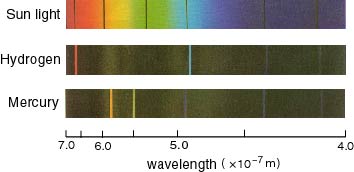
Spectra of Hydrogen and Mercury

New measurements of starlights suggest that the ratio of the proton's mass to the electron's mass has increased by 0.002% over 12 billion years. The spectra of hydrogen gas as recorded in lab is compared with spectra of light coming from hydrogen clouds billions of light years away when the universe was in its youth.

Molecular hydrogen absorbs light of specific wavelengths, and the resulting spectrum of "absorption lines" uniquely identifies Hydrogen atom by the 'bar' code made up of such lines. The positions of the lines depend on the ratio of the mass of the proton to the mass of the electron. Of course, one needs to carefully take into account the effect of the expansion of the universe which shifts these lines from higher (ultraviolet) to lower (visible) frequency.

The researchers have reported in Physical Review Letters this week that the mass-ratio of proton and electron (the ratio is about 1836 and is denoted by the letter mu) has increased by about 20 parts per million over the past 12 billion years. The proton-to-electron mass ratio figures in setting the scale of the strong nuclear force.

More studies of spectra of Hydrogen gas from distant galaxies are needed to confirm whether the mass ratio has indeed changed.

Here is the link to the abstract of the paper in Physical Review Letters.

Labels: ,


Monday, April 10, 2006

Neutrino Oscillation

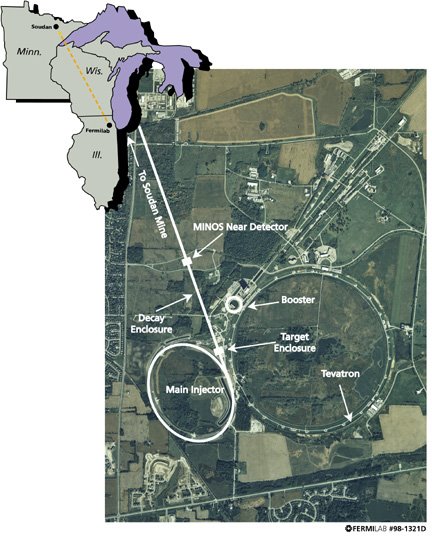
Photo Courtsey: Fermilab

An international collaboration of scientists at the Department of Energy's Fermi National Accelerator Laboratory have observed the disappearance of muon neutrinos traveling from the lab's site in Illinois to a particle detector in Minnesota. The observation is consistent with an effect known as neutrino oscillation, in which neutrinos change from one kind to another.

Neutrinos are ghost-like particles and rarely interact with matter. In this experiment, they travelled 450 miles straight through the earth from Fermilab to Soudan. They needed no tunnel because they do not interact with matter. The Main Injector Neutrino Oscillation Search (MINOS) experiment studies the neutrino beam using two detectors. The MINOS near detector, located at Fermilab, records the composition of the neutrino beam as it leaves the Fermilab site. The MINOS far detector, located in Minnesota, half a mile underground, again analyzes the neutrino beam. This allows scientists to directly study the oscillation of neutrinos among its 3 types: muon neutrinos, electron neutrinos or tau neutrinos under laboratory conditions.

The abundance of neutrinos in the universe, produced by stars and nuclear processes, may explain how galaxies formed and why antimatter has disappeared. Ultimately, these elusive particles may explain the origin of the neutrons, protons and electrons that make up all the matter in the world around us. The MINOS experiment revealed a value of delta m^2 = 0.0031 eV^2, a quantity that plays a crucial role in neutrino oscillations and hence the role of neutrinos in the evolution of the universe. An accurate measurement of this quantity is essential for understanding quantitatively how neutrinos behave and determine the fate of the universe in certain ways.

The MINOS experiment includes about 150 scientists, engineers, technical specialists, and students from 32 institutions in six countries, including Brazil, France, Greece, Russia, the United Kingdom, and the United States.

Further study:
Discovery of Neutrino Mass and Oscillation
The Neutrino Oscillation Industry

Labels: ,