.comment-link {margin-left:.6em;}

2Physics

2Physics Quote:
"Many of the molecules found by ROSINA DFMS in the coma of comet 67P are compatible with the idea that comets delivered key molecules for prebiotic chemistry throughout the solar system and in particular to the early Earth increasing drastically the concentration of life-related chemicals by impact on a closed water body. The fact that glycine was most probably formed on dust grains in the presolar stage also makes these molecules somehow universal, which means that what happened in the solar system could probably happen elsewhere in the Universe."
-- Kathrin Altwegg and the ROSINA Team

(Read Full Article: "Glycine, an Amino Acid and Other Prebiotic Molecules in Comet 67P/Churyumov-Gerasimenko"
)

Saturday, July 29, 2006

Most Accurate Clock

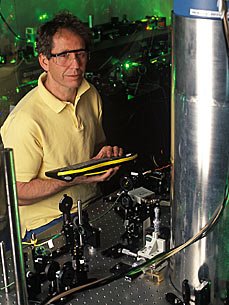
Photo: NIST physicist Jim Bergquist holds a portable keyboard used to set up the world's most accurate clock. The single mercury ion is contained in the silver cylinder in the foreground ©Geoffrey Wheeler (Courtsey: National Institute of Standards and Technology)

A path-breaking research paper by physicists at the National Institute of Standards and Technology (NIST) in the July 14 issue of Physical Review Letters describes an experimental atomic clock based on a single mercury atom, which at present is at least five times more precise than the national standard clock. The experimental clock consists of a silver cylinder which acts as a magnetic shield that surrounds a cryogenic vacuum system. The heart of the clock, a single mercury ion (electrically charged atom) is brought to rest inside this chamber by laser-cooling it to near absolute zero. The optical oscillations of the essentially motionless ion are used to produce the "ticks" or "heartbeat" of the world's most stable and accurate clock.

The mercury ion ticks at “optical” frequencies—much higher than the microwave frequencies measured in cesium atoms in NIST-F1, the national standard and one of the world’s most accurate clocks. This achievement of shifting the operation to higher frequencies allows time to be divided into smaller units and reach greater precision.

The current version of NIST-F1 —if operated continuously—would neither gain nor lose a second in about 70 million years. The latest version of the mercury clock would neither gain nor lose a second in about 400 million years.

This improved time and frequency standards would eventually lead to improved synchronization in navigation and positioning systems, telecommunications networks, and wireless and deep-space communications and would allow designing improved probes of magnetic and gravitational fields for security and medical applications. This would also let physicists investigate whether “fundamental constants” used in scientific research might be varying over time—a question that has enormous implications for understanding the origins and ultimate fate of the universe.

Here is the reference for the paper:
W.H. Oskay, S.A. Diddams, E.A. Donley, T.M. Fortier, T.P. Heavner, L. Hollberg, W.M. Itano, S.R. Jefferts, M.J. Jensen, K. Kim, F. Levi, T.E. Parker and J.C. Bergquist. 2006. A single-atom optical clock with high accuracy. Physical Review Letters. July 14.

Labels:


Monday, July 17, 2006

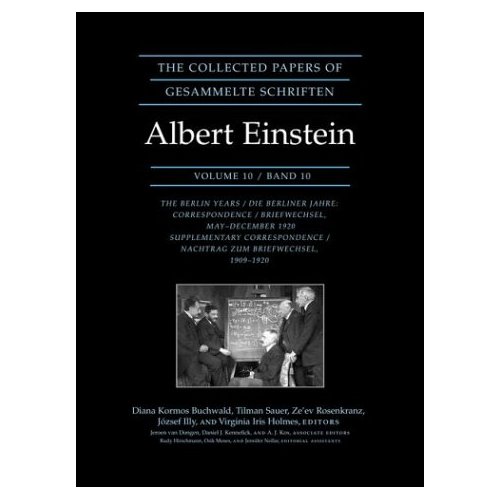
The Collected Papers of Albert Einstein, Vol. X

The 10th volume of The Collected Papers of Albert Einstein is being released this week by Princeton University Press under the editorship of the Einstein Papers Project at the California Institute of Technology. The Collected Papers of Albert Einstein is a collaborative project with participants from several countries. These volumes are edited by Diana Kormos-Buchwald, a professor of history at Caltech; Tilman Sauer, a senior research associate in history; Ze'ev Rosenkranz, Jozsef Illy, and Virginia Iris Holmes, members of the research staff in the Einstein Papers Project; and by associate editors Jeroen van Dongen, Daniel Kennefick, and A.J. Kox.

Volume 10 contains Einstein's correspondence from May to December 1920, as well as a substantial number of previously unavailable letters from 1909 to 1920, most of them written by Einstein. These originate from the bequest of family correspondence deposited at the Albert Einstein Archives at the Hebrew University in Jerusalem by his stepdaughter Margot Einstein, who stipulated that they remain closed for twenty years after her death.

In the latter half of 1920, Albert Einstein faced a series of increasingly acrimonious public attacks against his recently confirmed theory of general relativity. He considered leaving Berlin, which would have deprived Germany of its most famous scientist. Colleagues, friends, and unknown admirers offered support, while Einstein worried about the care of his two sons and ex-wife in Switzerland, and his new family in Berlin.

Scientific issues are discussed in the correspondence as well, shedding light on his associations with fellow physicists in Europe and the United States, and his lectures on the special and general theories of relativity within Germany and during his trips to Holland, Denmark, and Norway. The documents present the challenges Einstein faced as a result of his recently acquired celebrity status, his subsequent entrance into the public arena, and the contentious public attacks against relativity.

The intensity of this period, during which anti-Semitism and nationalistic sentiment seeped into scientific debate, is reflected in numerous letters. The successful completion of the intricate process of Einstein's appointment as Special Professor at the University of Leyden leads to his well-known inaugural lecture on "Ether and Relativity" in October 1920. The letters document in detail his sojourns in the Netherlands, the hospitality of many Dutch colleagues, his involvement with issues at the forefront of physics, and especially his significant intellectual and personal bonds with Paul Ehrenfest. He visits Oslo and Copenhagen, where he meets with Niels Bohr, and receives invitations to America.

The hardbound copy costs $110. The paperback copy costs $45.

[News Source: Caltech Media Relations, Pasadena, CA 91125]

Labels: ,


Monday, July 10, 2006

Upcoming Physics Conferences

From today we start this feature on suggestion from some of our physicist friends. If anyone wishes to freely advertize Physics jobs or conferences in 2Physics, he/she is welcome to put an entry and a web-link following our 'comment' link that can be found at the bottom of any of our postings. From time to time we'll publish the list. Our today's list is for conferences only.

July 18-21: "Quantum reality, relativistic causality, and closing the epistemic circle: an international conference in honour of Abner Shimony" (Waterloo, Ontario, Canada)
July 20-21: "Teaching General Relativity" (Syracuse)
July 23-29: "Eleventh Marcel Grossmann Meeting on General Relativity" (Berlin)
Jul 31-Aug 4: "Cosmic Frontiers" (Durham, UK)
August 1-4: "1st international workshop on transmission of information and energy in nonlinear & complex systems " (Singapore)
August 6-11: "Intl congress on mathematical physics" (Rio de Janeiro, Brazil)
August 7-15: "Key Approaches to Dark Energy" (Barcelona, Spain)
August 24-26: "Quantum Gravity in Americas" (Pennstate)
August 25-29: "3rd Feynman festival" (College Park, Maryland, USA)
September 3-12: "International advanced summer school on modern mathematical physics: theoretical cosmology and observational status of modern cosmology" (Dubna, Russia)
September 7-9: "Maxwell 150 Years On" (Aberdeen, UK)