.comment-link {margin-left:.6em;}

2Physics

2Physics Quote:
"Many of the molecules found by ROSINA DFMS in the coma of comet 67P are compatible with the idea that comets delivered key molecules for prebiotic chemistry throughout the solar system and in particular to the early Earth increasing drastically the concentration of life-related chemicals by impact on a closed water body. The fact that glycine was most probably formed on dust grains in the presolar stage also makes these molecules somehow universal, which means that what happened in the solar system could probably happen elsewhere in the Universe."
-- Kathrin Altwegg and the ROSINA Team

(Read Full Article: "Glycine, an Amino Acid and Other Prebiotic Molecules in Comet 67P/Churyumov-Gerasimenko"
)

Monday, August 28, 2006

Dark Matter

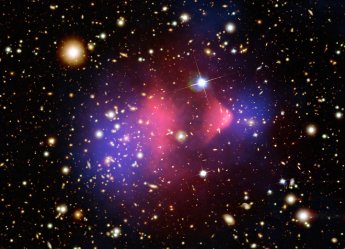
(Image: courtesy of Chandra X-ray Observatory) Image of two colliding galaxy clusters showing x-ray and optical radiation. Hot gas detected by Chandra in x-ray part of the spectrum is seen as two central pink clumps in the image and contains most of the normal or baryonic matter in the two clusters. The optical image from Magellan and the Hubble Space Telescope shows the galaxies in orange and white. The blue parts in this image show areas where most of the mass in the clusters is found and are believed to be consisting of dark matter.

We can see ordinary matter or can feel its presence through the energy it emits in various parts of the electromagnetic spectrum, like radiowave, x-ray, microwave, gamma ray etc. Dark matter is exotic in the sense that it does not interact with any kind of electromagnetic wave and so can remain invisible to all kinds of telescopes that man have built. However, still we can feel its presence by some expected or weird movement of stars or galaxies around it because dark matter cannot escape the force of gravity. In fact, dark matter was originally hypothesized to explain the abnormally high rotation speeds of galaxies, which would otherwise be torn apart if they did not contain hidden mass. Astronomers estimate that dark matter and dark energy account for 80 to 90 percent of the matter in the universe. The more familiar kind of matter, which can be seen and felt, makes up the rest.

A solid evidence supporting the existence of this elusive matter has been absent for a long time. A group of US astromers led by Doug Clowe recently reported an exciting account of its presence by analyzing observational data from NASA's Chandra X-ray Observatory, the Hubble Space Telescope, the European Southern Observatory's Very Large Telescope and the Magellan optical telescopes for a violent collision between two large galaxy clusters 3 billion light years away. Their analysis is going to be published in forthcoming issues of Astrophysical Journal and Astrophysical Journal Letters.

Behind these observations lies a remarkable bullet-shaped cloud of hot gas produced by the collision of two clusters. As they cross at 10 million miles per hour, the luminous matter in each interacts with the other and slows down. But the dark matter does not interact at all, passing right through without disruption. This causes the dark matter to sail ahead, separating each cluster into two components: dark matter in the lead and luminous matter lagging behind.

To detect this seDoug Cloweparation, researchers compared x-ray images of the luminous matter with measurements of the cluster's total mass through gravitational lensing. This involves the observation of the distortion of light from background galaxies by the cluster's gravity -- the greater the distortion, the more massive the cluster. The team discovered four separate clumps of matter (see the photo) : two large clumps of dark matter speeding away from the collision, and two smaller clumps of luminous matter trailing behind, proving two types of matter exist.

Team members who accomplished this break-through research are: Doug Clowe and Dennis Zaritsky of Uuniversity of Arizona's Steward Observatory; Marusa Bradac of the Kavli Institute for Particle Astrophysics and Cosmology in Stanford, Calif.; Anthony Gonzalez of the University of Florida, and Maxim Markevitch, Scott Randall and Christine Jones of the Harvard-Smithsonian Center for Astrophysics.
photo of Doug Clowe (courtsey: University of Arizona)

Labels:


Wednesday, August 09, 2006

James Van Allen (1914-2006)

Photo by Tom Jorgensen. Courtsey: University of Iowa Office of University Relations.

Physicist James A Van Allen, a pioneer in space exploration who discovered the radiation belts surrounding the Earth that now bear his name died Wednesday morning, Aug. 9, 2006, of heart failure at University of Iowa Hospitals and Clinics. He was 91.
He was Regent Distinguished Professor of Physics in the University of Iowa College of Liberal Arts and Sciences.

Van Allen gained global attention in the late 1950s when instruments he designed and placed aboard the first US satellite, Explorer I, discovered the bands of intense radiation that surround the earth. The bands, later named in his honor, spawned a new field of research known as magnetospheric physics, an area of study that now involves more than 1000 investigators in more than 20 countries.

The discovery propelled the United States in its space exploration race with the Soviet Union and prompted Time magazine to put Van Allen on the cover of its May 4, 1959, issue. Among the other accomplishments of which he was most proud was his 1973 first-ever survey of the radiation belts of Jupiter using the Pioneer 10 spacecraft and his 1979 discovery and survey of Saturn's radiation belts using data from the Pioneer 11 spacecraft.

Between 1949 and 1962 he was the leader of a number of scientific expeditions to study cosmic rays and the Earth’s magnetic field, using American ships, in the Central Pacific, the Gulf of Alaska, the Arctic, the Atlantic, Central Pacific, South Pacific and Antarctic areas. He pioneered the use of balloons, Aerobee rockets and the combination of the two, for the measurement of the intensity of cosmic rays at high altitudes. It was this work that led to his involvement in Explorer 1 and the discovery of the belts that bear his name.

Even though he retired from full-time teaching in 1985, Van Allen continued to monitor data gathered by other satellites and served as an interdisciplinary scientist for the Galileo spacecraft, which reached Jupiter in 1995.

Van Allen published more than 280 research papers in scientific journals and research monographs. He edited the book Scientific Uses of Earth Satellites (1958); co-authored Pioneer — First to Jupiter, Saturn and Beyond (1980); wrote Origins of Magnetospheric Physics (1983); wrote 924 Elementary Problems and Answers in Solar System (1993); and edited Cosmic Rays, The Sun and Geomagnetism: The Works of Scott E. Forbush (1993).

Labels:


Monday, August 07, 2006

Reflection of Atoms

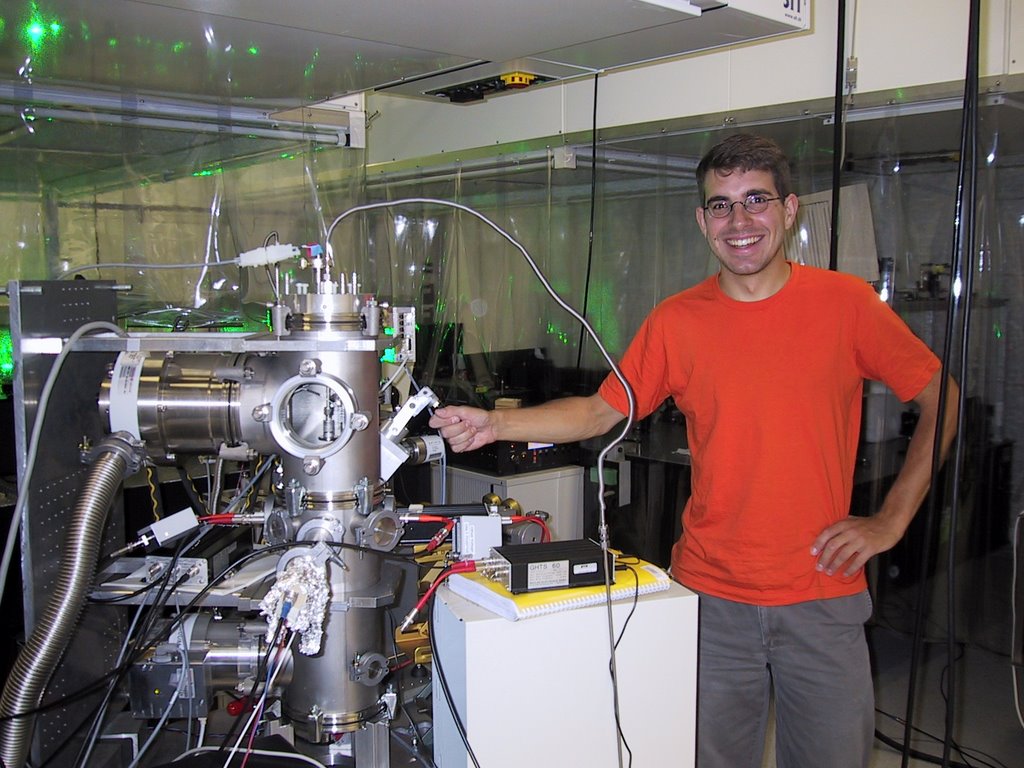
Graduate Student Edward Vliegen with his 'atom-reflecting' set-up

So far, physicists could succeed in developing lenses and prisms to manipulate beams of atoms and molecules as though they were beams of light. Such techniques were used to manipulate atoms in studies of atomic properties, in research on ultra-cold quantum states of atoms, and in devices like atom-based gyroscopes and atomic clocks.

But as far as the reflection is concerned there had only been some limited success. In the past researchers have built mirrors for ground state molecules that have electric dipole moments as an outcome of asymmetries in the locations of positive and negative charges in their molecular structures. Some researchers tried to reflect atoms and molecules excited into very high, so-called Rydberg states, which also have large dipole moments. But they failed to bounce those atoms straight back from a head-on collision. Atoms could only graze off at shallow angles.

Now, Edward Vliegen and Frederic Merkt of the Swiss Federal Institute of Technology (ETH) in Zurich have reported that they were able to stop and then reflect these so-called "Rydberg atoms" using a system of electric fields. Rydberg atoms are unusual in that they contain an electron that has been excited to such a high energy level that it orbits a very long way from the nucleus. Since the outer electron is so loosely bound, Rydberg atoms are highly sensitive to external perturbations, such as electric fields. In the present study, for example, hydrogen atoms were used in which the electron had been excited by a laser beam so that its principal quantum number, n, was 27. The electron in one of these atoms can be as far as 37 nm from the nucleus.

Vliegen and Merkt began by using a laser to split up ammonia (NH3) in a quartz capillary tube. As the gas left the tube, it underwent a supersonic expansion so that the hydrogen atoms were traveling at a speed of 720 meter per second. The atoms then entered a gap between four metallic electrodes, where there is a rapidly changing electric field. As they did so, the atoms were excited by two ultraviolet laser beams to create Rydberg states. By applying a sequence of voltages to the four electrodes, Vliegen and Merkt found that they could stop the Rydberg atoms in a time of 4.8 ms just 1.9 mm away from the position where the atoms were excited by the laser beams. They were then able to reflect the atoms back from the middle of the plates to their original positions with accelerations of 2 x 10⁸ ms-2. And since the atoms are focused about six microseconds after being reflected, Vliegen claims that their mirror also works as a cylindrical lens.

There could be some interesting applications of this work. According to Vliegen, the new mirror could be used to perform interferometry experiments with Rydberg atoms. He even thinks the mirror could help prevent antihydrogen Rydberg atoms generated at the CERN “antimatter factory“ from colliding with the walls of the experiment chamber and annihilating there.

Reference:
"Normal-Incidence Electrostatic Rydberg Atom Mirror", E. Vliegen and F. Merkt,
Phys. Rev. Lett. 97, 033002 (issue of 21 July 2006)

To know more about Rydberg atom, visit: Wikipedia page on Rydberg atom

Labels: ,