.comment-link {margin-left:.6em;}

2Physics

2Physics Quote:
"Many of the molecules found by ROSINA DFMS in the coma of comet 67P are compatible with the idea that comets delivered key molecules for prebiotic chemistry throughout the solar system and in particular to the early Earth increasing drastically the concentration of life-related chemicals by impact on a closed water body. The fact that glycine was most probably formed on dust grains in the presolar stage also makes these molecules somehow universal, which means that what happened in the solar system could probably happen elsewhere in the Universe."
-- Kathrin Altwegg and the ROSINA Team

(Read Full Article: "Glycine, an Amino Acid and Other Prebiotic Molecules in Comet 67P/Churyumov-Gerasimenko"
)

Monday, September 25, 2006

B_s meson: Matter to/from Antimatter 3 million times a second

Christoph Paus of MIT announcing the discovery at Fermilab (photo courtsey: Fermilab)

After 2 decades of painstaking research with monumentally precise technology, scientists of the CDF collaboration at the Department of Energy's Fermi National Accelerator Laboratory announced today that they have met the exacting standard to claim discovery of astonishingly rapid transitions of the B_s meson between matter and antimatter 3 trillion times a second.

Immediately after the Big Bang some 13 billion years ago equal amounts of matter and antimatter formed. Much of it quickly acted to annihilate the other, but for little-understood reasons a bit more matter than antimatter survived, providing the universe with the planets, stars and galaxies visible today. Particles that bridge the two worlds, such as the B_s (pronounced B-sub-s) meson, normally don't exist on their own but can be created in the great collisions generated by particle accelerators, which attempt to duplicate conditions close to the Big Bang. Studying the particles helps scientists understand the evolution of the universe.

The B_s meson consists of the heavy bottom quark bound by the strong nuclear interaction to a strange antiquark. The incredibly rapid commuting rate of the B_s meson particle had been predicted by the Standard Model, the successful but still incomplete theory aimed at explaining how matter and energy interact to form the visible universe. The discovery of this oscillatory behavior is thus another reinforcement of the Standard Model's durability.

Many different theoretical models of how the universe works at a fundamental level will now be confronted with the CDF discovery. The currently popular models of supersymmetry, for example, predict a much higher transition frequency than that observed by CDF, and those models will need to be reconsidered.

It must be recalled that scientists at Fermilab also discovered two of the most fundamental particles, the bottom quark in 1977 and in 1995 the top quark, one of the constituent particles of protons, which form the nuclei of atoms.

The results have been submitted in a paper to Physical Review Letters.

Labels:


Monday, September 11, 2006

Spin Hall Effect

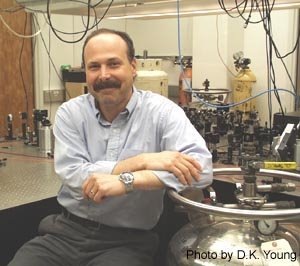
David Awschalom (courtsey: Awschalom Group, Physics Dept, Univ. of California, Santa Barbara)

The Hall effect, as discovered by Edwin Hall in 1879, refers to the potential difference induced on opposite sides of a thin sheet of conducting or semiconducting material called 'Hall element' when the element is subject to crossed electric and magnetic fields. As a result of this potential diffference, a charge current transverse to both the applied fields appears.

In a research paper published in September 1st issue of Physical Review Letters (full reference below), David Awschalom and colleagues at the Center for Spintronics and Computation at the University of California, Santa Barbara reported the current-induced spin-polarization of electrons and the spin Hall effect in thin surface layers of ZnSe at room temperature.

The spin Hall effect was first observed in GaAs at 20K by Awschalom and Yuichiro Kato in 2004. In an analogy to the conventional Hall effect, the spin Hall effect refers to a pure spin current transverse to an applied electric field in the absence of applied magnetic fields, and was theoretically predicted more than 30 years ago. A pure spin current is a flow of spin angular momentum without any charge current, which can be realized, for example, by spin-up and spin-down electrons moving in opposite directions. At the edges of a sample, the spin current results in accumulation of spins, similar to charge accumulation in the conventional Hall effect.

The unique advantage of using the spin Hall effect is that it does not require a magnetic field or magnetic materials to generate and separate spins in the solid state. The effect could be of use in the growing field of spintronics, in which the intrinsic spin of the electron (in addition to its electrical charge) is exploited in the development of logic devices. The spin Hall effect could provide a source of spin-polarized electrons for injection into semiconductor devices. Such electrons could carry information based on the state (up or down) of their spin polarization.

The spin polarization at 20K was about ten times stronger than at room temperature. Currently, the research team is working to boost the level of spin polarization to levels where nearly all electrons are polarized.

Reference: "Generating Spin Currents in Semiconductors with the Spin Hall Effect", V. Sih, W. H. Lau, R. C. Myers, V. R. Horowitz, A. C. Gossard, and D. D. Awschalom, Phys. Rev. Lett. 97, 096605 (2006).
Study of background materials:
Wikipedia page on 'Hall effect'
Wikipedia page on 'Quantum Hall effect'
"Observation of the spin Hall effect in semiconductors", Y. K. Kato, R. C. Myers, A. C. Gossard, and D. D. Awschalom,
Science Express 1105514 (2004)

Labels:


Tuesday, September 05, 2006

Upcoming Physics Conferences

Here is a selected list of forthcoming conferences in Physics. You are welcome to freely advertise Physics jobs or conferences in 2Physics by sending an email to 2Physics@gmail.com.

September 3-12: "International advanced summer school on modern mathematical physics: theoretical cosmology and observational status of modern cosmology" (Dubna, Russia)
September 7-9: "Maxwell 150 Years On" (Aberdeen, UK)
September 10-23: "XII Brazilian School on Cosmology and Gravitation" (Rio de Janeiro, Brazil)
September 17-23: "School in string theory" (Bhubaneswar, India)
September 25-29: "COSMO 2006: International Workshop on Particle Physics and Early Universe" ( Lake Tahoe, CA, USA)
October 6-8: "Mensa colloquium 2006: revolution in cosmology" (Albany, NY, USA)
October 26-28: "10th Paris Cosmology Colloquium" (Paris, France)
November 6-9: "Nanoscience & nanotechnology 2006" (Rome, Italy)
December 17-19: Intl workshop on neutrino masses and mixings - toward unified understanding of quark and lepton mass matrices (Shizuoka, Japan)