.comment-link {margin-left:.6em;}

2Physics

2Physics Quote:
"Many of the molecules found by ROSINA DFMS in the coma of comet 67P are compatible with the idea that comets delivered key molecules for prebiotic chemistry throughout the solar system and in particular to the early Earth increasing drastically the concentration of life-related chemicals by impact on a closed water body. The fact that glycine was most probably formed on dust grains in the presolar stage also makes these molecules somehow universal, which means that what happened in the solar system could probably happen elsewhere in the Universe."
-- Kathrin Altwegg and the ROSINA Team

(Read Full Article: "Glycine, an Amino Acid and Other Prebiotic Molecules in Comet 67P/Churyumov-Gerasimenko"
)

Thursday, January 19, 2006

A Briefer History of Time
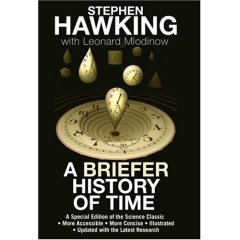
A Briefer History of Time
By Stephen Hawking with
Leonard Mlodinow
(Bantam, 2005, 176 pp.)

A Brief History of Time by Stephen Hawking was published in 1988 and was a surprise best-seller among a wide range of readership. In the 17 years since that time, new data from observational astronomy and particle physics have shed light from different angles on the problem of finding a Grand Unified Theory of Everything that could answer many basic questions about the universe: from where did it come and where it's going.

In this new volume Hawking and Mlodonow explains, in a popular way, the theories of the Big Bang origin of the Universe, the special and general theories of relativity, quantum theory, black holes, and some ever-exciting topics like time travel. They discussed at length the topics of the mysterious dark matter and dark energy - both of which can only be observed by their gravitational effects and are believed to make up 90% of the universe. The book also discusses another thriving area of research: Superstring theory, its achievement in last 20 years and how far it could go in search of a final theory.

Although it's written in a simple style, just like the Brief history, the Briefer history might also turn out to be a tough read for those who do not have a good background in Physics. However, it provides some amazing insight into the thinking process of some of the most intelligent minds of the world and how they are trying to decipher the riddles of the universe. It would be a great experience to be a part of that venture through the pages of this book.


Sunday, January 08, 2006

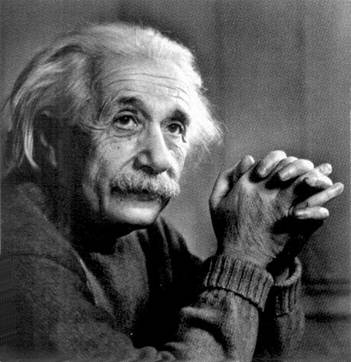
Einstein Is Precisely Right

Precise tests of the predictions of Einstein's Theory of Relativity are important because special relativity is a central principle of modern physics and the basis for many scientific experiments as well as useful instruments like the global positioning system (GPS).

The December 21st issue of Nature carries an article describing an experiment that performed the most precise direct test ever of what is perhaps the most famous formula in science: E=mc^2, or that the energy (E) equals mass (m) times the square of the speed of light (c^2), a direct outcome of Einstein’s theory of special relativity.

The experiment was performed by scientists at the Massachusetts Institute of Technology (MIT), the Commerce Department’s National Institute of Standards and Technology (NIST), and the Institute Laue Langevin, Genoble, France (ILL) .

According to the basic laws of physics, every wavelength of electromagnetic radiation corresponds to a specific amount of energy. The NIST/ILL team of scientists determined the value for energy in the Einstein equation by carefully measuring the wavelength of gamma rays emitted by silicon and sulfur atoms. Then comparing these numbers and MIT measurements of the mass of the same atoms, the scientists found that E differs from mc^2 by at most 0.0000004, or four-tenths of 1 part in 1 million. This result is “consistent with equality” and is 55 times more accurate than the previous best direct test of Einstein’s formula.

Congratulations, Mr. Einstein! It was a good way to end the Year of Physics.

Labels: