.comment-link {margin-left:.6em;}

2Physics

2Physics Quote:
"Many of the molecules found by ROSINA DFMS in the coma of comet 67P are compatible with the idea that comets delivered key molecules for prebiotic chemistry throughout the solar system and in particular to the early Earth increasing drastically the concentration of life-related chemicals by impact on a closed water body. The fact that glycine was most probably formed on dust grains in the presolar stage also makes these molecules somehow universal, which means that what happened in the solar system could probably happen elsewhere in the Universe."
-- Kathrin Altwegg and the ROSINA Team

(Read Full Article: "Glycine, an Amino Acid and Other Prebiotic Molecules in Comet 67P/Churyumov-Gerasimenko"
)

Saturday, February 25, 2006

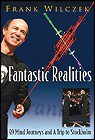
Fantastic Realities

Fantastic Realities
ed:
Frank Wilczek
Pub: World Scientific, Singapore
ISBN 981-256-649-X

500pp (approx.)
(to be published soon)

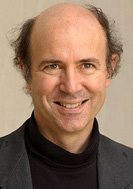
If you love Physics and wish to have a relaxation of mind, here is a book we recommend to you. Frank Wilczek is the charismatic Physics Professor at MIT and recipient of 2004 Nobel Prize. He is known, among other things, for the discovery of asymptotic freedom, the development of quantum chromodynamics, axions, and the discovery and exploitation of new forms of quantum statistics (anyons).

This book consists of 49 pieces, including many from Wilczek’s award-winning 'Reference Frame' columns in 'Physics Today' and some of them are never before published. The articles are gathered by style and subject into a dozen chapters, each with a revealing, witty introduction.
It has everything that can please, amuse and entertain your mind and brain: jokes, some poems, and extracts from wife Betsy Devine’s sparkling chronicle of what it’s like to live through a Nobel Prize. There’s also some history, some philosophy, some exposition of frontier science for your lasting edification -- You know what to expect if you are a regular follower of Frank's 'reference frame' columns.

The book is going to hit the stand soon in the forthcoming spring and we are predicting a big success.

Congratulations Frank ... for thinking of such a wonderful book and finding time to deliver it for our pleasure.


Sunday, February 19, 2006

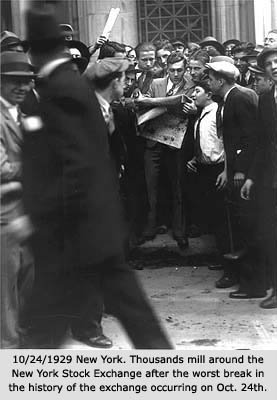
Physics of Stock Market Crash

In a recent article "Criticality and Phase Transition in Stock-Price Fluctuations" published in Physical Review Letters (February 17, 2006), a University of Tokyo team consisting of Ken Kiyono, Zbigniew R. Struzik and Yoshiharu Yamamoto reports about their research findings that in the months before and after a major stock market crash, price fluctuations follow patterns similar to those seen in natural phenomena such as heartbeats and earthquakes.

The researchers studied the Standard & Poor's S&P 500 index, focusing on small deviations from long-term index trends. Such up-and-down blips in stock prices are usually "Gaussian," or "normally" random, at least when measured over sufficiently long time scales -- for example, for more than one day. That means that fluctuations are likely to be small, while larger fluctuations are less likely, their probabilities following a bell curve.

But when they looked at 2-month periods surrounding major crashes such as the Black Monday event of October 19, 1987, they saw something different: Fluctuations of all magnitudes were equally probable. As a consequence, the graph of index fluctuations looked statistically similar if plotted over different time scales, anywhere between time scales of 4 minutes and two weeks. Such behavior is called critical in analogy with a ferromagnetic metal at the "critical temperature," when regions form where the metal's atoms arrange their spins in the same direction, and these regions look similar at different levels of magnification. This self-similarity is also seen in the time intervals between heartbeats, or between earthquakes. Mathematically, however, the stock market case differs in that the probabilities do not change with the size of the event, while in other cases of non-critical self-similarity, the probabilities usually follow a so-called power law.

It is still unclear which individual trading decisions lead to criticality in the stock market or whether the findings could one day lead to an early-warning system to predict crashes. If such predictions can be made with certainty, we hope the uncertainty in Physics research budgets would vanish for ever ;-)

Labels: