.comment-link {margin-left:.6em;}

2Physics

2Physics Quote:
"Many of the molecules found by ROSINA DFMS in the coma of comet 67P are compatible with the idea that comets delivered key molecules for prebiotic chemistry throughout the solar system and in particular to the early Earth increasing drastically the concentration of life-related chemicals by impact on a closed water body. The fact that glycine was most probably formed on dust grains in the presolar stage also makes these molecules somehow universal, which means that what happened in the solar system could probably happen elsewhere in the Universe."
-- Kathrin Altwegg and the ROSINA Team

(Read Full Article: "Glycine, an Amino Acid and Other Prebiotic Molecules in Comet 67P/Churyumov-Gerasimenko"
)

Sunday, July 31, 2005

Quarks on a chip

Quarks are considered to be fundamental building blocks of matter and
are bound together inside subatomic particles by the 'strong nuclear
force' (see our past posting), which is weak when the quarks are close,
but increases steadily as they move apart, making it impossible to isolate
a single quark.

Quarks are the inner constituents of 99.9% of ordinary matter; yet it is
impossible to examine a single quark in the laboratory. Consequently,
some of their basic properties are not known, such as their precise masses
or why they exist in 6 different types.

In order to understand Quarks, the theory describing the strong nuclear
force, called Quantum Chromodynamics (QCD), has to be simulated on
huge computers. Particle physicists are embarking on a new attempt to
resolve the mysteries of quarks using 3 purpose-designed computers
that employ QCD-on-a-chip, or QCDOC, technology.

The first of the three computers is located at the University of Edinburgh
(UK), for use by the UK Quantum Chromodynamics (UKQCD)
collaboration of scientists from 7 British universities. The 2nd is at the
RIKEN Brookhaven Research Center in Brookhaven National Laboratory
in the USA. The 3rd, part of the US Department of Energy's programme
in high energy and nuclear physics, is also at Brookhaven.

A little slower than a PC's microprocessor, the QCDOC chip was designed
to consume a 10th of the electrical power, so that tens of thousands of
them could be put into a single machine. Each machine operates at a speed
of 10 Teraflops, or 10 trillion (i.e. million million) floating point operations
per second. By comparison, a regular desktop computer operates at a few
Gigaflops (a thousand million floating point operations per second), while
IBM's BlueGene, a close relative of QCDOC and the fastest computer in
the world, operates at more than 100 Teraflops.

Labels:


Tuesday, July 19, 2005

Through Einstein's Eyes


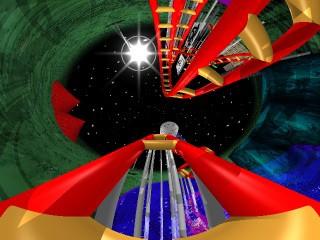
Relativistic ride on a roller coaster &
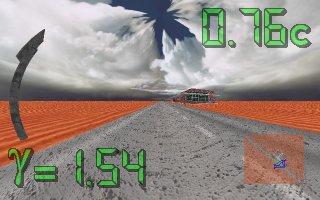
On a desert road at relativistic speed (0.76 times the speed of light)

If you love relativity and get amazed thinking about all its seemingly wierd
concepts and consequences, you would surely like the following websites of
the Physics department of Australian National University (ANU):

Seeing Relativity :
The Australian National University relativistic visualization project has
used supercomputers to simulate what we might see in a world where the
effects of Einstein's theory of special relativity are everyday experiences.
You can also download two extended relativistic optics videos,
Visualizing Special Relativity, and Seeing Relativity, in RealPlayer format.
A complete printer-friendly commentary is also available for the videos.

Through Einstein's Eyes Online :
You may also visit the Through Einstein's Eyes site to find out about their
latest multimedia work on relativistic visualisation.

Labels:


Tuesday, July 05, 2005

The Millennium Simulation

It is called the Millennium Simulation. It was a big job undertaken by the
Virgo consortium, an international group of astrophysicists from the UK,
Germany, Canada and the US. The consortium modeled more than 10
billion particles of matter in order to trace the evolution of the
distribution of matter within a cubic region of the universe measuring
more than 2 billion light-years each side.

It kept the principal supercomputer at the Max Planck Society's
Supercomputing Centre in Garching, Germany fully occupied for more
than a month. By applying sophisticated modeling techniques to the 25
terabytes of output, Virgo scientists have simulated evolutionary
histories for the galaxies (approximately 20 million of them) that populate
this volume, and for the super-massive black holes occasionally seen as
quasars at their hearts.

The Millennium Simulation was designed to follow the evolution of the
universe from when it was just 400,000 years old (the point from which
it has been imaged using microwave telescopes) to the present day. It
has the twin goals of exploring the complex physics that gave rise to
galaxies and their central black holes and of checking that the new
paradigm for cosmic evolution emerging from this activity is consistent
with what is observed.

The Sloan Digital Sky Survey had discovered earlier a number of very
distant and bright quasars, which appear to host black holes a billion
times more massive than the sun, at a time when the universe was less
than a tenth its present age. Many astronomers considered this
observation impossible to reconcile with the gradual growth of structure
predicted by the standard models. Yet the galaxy and quasar formation
modelling found that a few massive black holes do form early enough to
account for these very rare type of quasars.

The most interesting aspect of the preliminary results is that they
demonstrate that the characteristic patterns imprinted on the
distribution of matter at early epochs should still be present - and
detectable - in the observed distribution of galaxies. Measuring these
should provide a standard measuring rod to characterise the geometry
and expansion history of the universe and so to learn about the nature
of the Dark Energy.