.comment-link {margin-left:.6em;}

2Physics

2Physics Quote:
"Many of the molecules found by ROSINA DFMS in the coma of comet 67P are compatible with the idea that comets delivered key molecules for prebiotic chemistry throughout the solar system and in particular to the early Earth increasing drastically the concentration of life-related chemicals by impact on a closed water body. The fact that glycine was most probably formed on dust grains in the presolar stage also makes these molecules somehow universal, which means that what happened in the solar system could probably happen elsewhere in the Universe."
-- Kathrin Altwegg and the ROSINA Team

(Read Full Article: "Glycine, an Amino Acid and Other Prebiotic Molecules in Comet 67P/Churyumov-Gerasimenko"
)

Sunday, September 25, 2005

Force & Matter Wave

Background of this report:
What is matter wave? The idea that atoms behave as waves as well as particles
goes back to 1924. They're called "de Broglie waves" for early 20th-century French
quantum physicist Prince Louis-Victor de Brogli, who first proposed the concept of
atom waves. Physicists have grappled with the dual wave-particle nature of atoms
for decades and, in the 1990s, they began chilling atoms to near absolute zero and
studying the wave properties of atoms in detail. The de Broglie wavelength is Planck
Constant [6.626X10^(-34) Joule-sec] divided by the momentum (mass X velocity)
of a particle.
What is van der Waals force? All atoms and molecules exhibit weak, short-
range interactions for one another. These forces are responsible for the condensation
of gases into liquids and the freezing of liquids into solids despite the absense of ionic,
covalent or metallic bonding mechanisms. The familiar aspects of behavior of matter
in bulk such as friction, surface tension, viscosity, adhesion, cohesion and so on also
arise from vander Waals forces. The van der Waals attraction between 2 molecules
at distance 'd' apart is proportional to 1/d^7 (^ stands for 'to the power of') and so is
significant only for molecules very close together.
Report: University of Arizona physicists
have directly measured how close
speeding atoms can come to a surface
before the atoms' wavelengths change.
This is a first, fundamental measurement
that confirms the idea that the wave of
a fast-moving atom shortens and
lengthens depending on its distance
from a surface, an idea first proposed by
pioneering quantum physicists in the late
1920s.

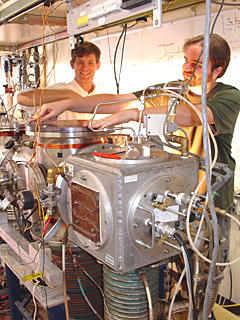
UA optical sciences doctoral candidate
John D. Perreault (right in picture) and
UA assistant professor of physics
Alexander D. Cronin (left in picture)
report the experiment in the Sept. 23
Physical Review Letters. You can read
the paper here.

Perreault and Cronin found that atoms
closer than 25 nanometers to a surface
are very strongly attracted to the
surface because of the van der Waals
interaction -- so strongly that the atoms are accelerated with the force of a million g's.
A "g" is a term for acceleration any object on earth feels due to gravity (about 9.8 meter/second^2). A roller coaster rider might feel 3 to 4 g's for brief moments during
a ride. Fighter pilots can experience accelerations of up to 8 g for brief periods during
tactical maneuvers, but can black out if subjected to 4 to 6 g's for more than a few
seconds.

The measurement tells nanotechnologists how small they can make extremely tiny
devices before a microscopic force between atoms and surfaces, called van der Waals
interaction, becomes a concern. The result is important both for nanotechnology,
where the goal is to make devices as small as a few tens of billionths of a meter, and
for atom optics, where the goal is to use the wave nature of atoms to make more
precise sensors and study quantum mechanics.

Source of report: Univ of Arizona Original news release

Labels: ,


Saturday, September 10, 2005

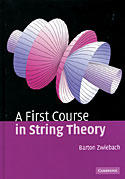
First Course: String Theory

Barton Zwiebach is a respected teacher at MIT and a well
-known researcher in the field of string theory. Here is a
great book written by him with the goal of making string
theory accessible to advanced undergraduates:

A First Course in String Theory
-- Barton Zwiebach
Cambridge U. Press, New York, 2004. $65.00 (558 pp.).
ISBN 0-521-83143-1

String theory aimed to give mankind the theory of everything
with its elegant mathematical formulation using the beautiful
symmetries of mathematics and presumably of the nature.
Many saw a great prospect of covering the whole realm
of the physical world
by a single underlying theory. It promised of a well -behaved
quantum theory of gravity that would also unify all four fundamental interactions
of nature.

However, years of research by some of the best minds in Physics and
Mathematics have failed to sustain the initial enthusiasm that it generated
especially in 1980s. The reason is the lack of experimental evidence supporting
the theory and its twin cornerstones: supersymmetry and extra spatial
dimensions. String theorists have struggled to come up with testable predictions
that could vindicate their ideas. It has gone far ahead of the current day
technology which even struggles to validate some of the ideas and concepts of
the so-called Standard Model of particle physics (and not to mention the large
amount of money it needs to pursue such experimental studies -- a factor
that caused chronic problems in high energy physics research).

We donot know if in our lifetime we would be able to see any real breakthrough
in the understanding of the underlying theory that would come from String
theory -- but String theory would still remain to an elegant beautiful creation
by some of the best intellects of the world.

This book is a great one for students as well as seasoned researchers and gives
very well-explained introduction to entities like light-cone gauge, D-branes,
Dp-branes, T-duality of closed and open strings, 11D M-theory, and so on so
forth -- the terms which you cannot expect to stumble upon in all other kinds
of Physics.

Useful Link: The best website for starting to know more about String theory
is this website designed and managed by Patricia Schwarz, wife of the
celebrated Physics Professor of Caltech, John Schwarz. During the mid-1980s
John Schwarz and Michael Green energized the whole field by showing that
the infinities of the theory can be tamed by supersymmetry, a concept that
generated lot of enthusiasm at that time. As a bonus, they also predicted the
dimensionality of spacetime to be 10 -- and not just 4. So, explore and enjoy
the site: http://superstringtheory.com/


Tuesday, September 06, 2005

Bose-Einstein condensate


About 80 years ago, based on previous work by the Indian physicist
Satyendra Nath Bose, Einstein proposed that if a gas of neutral atoms is
cooled to a low enough temperature, all atoms of the gas would fall into the
same quantum state. In other words, all of the million or billion atoms in
the gas would end up in the same place at the same time, a weird quantum
state dubbed a Bose-Einstein condensate.

The supercold atoms are created from a hot gas of neutral atoms that is
laser cooled, collected in a magneto-optic trap, cooled further by evaporation,
and then spun off into a magnetic trap for a few seconds of study before it
warms up and dissipates.

A team of physicists at UC Berkeley has created a Bose-Einstein condensate
of rubidium atoms and nudged it into a circular racetrack 2 millimeters
across, creating a particle storage ring analogous to the accelerator storage
rings of high energy physics. This ring, the first to contain a Bose-Einstein gas,
is full of cold particles at a temperature of only one-millionth of a degree
above absolute zero (which is -273 degree centigrade), traveling with
energies a billion trillion times less than the particles in a high-energy storage
ring [The atoms circled the racetrack at a speed of about 50 to 150 millimeters
per second, which is equal to an energy of about one nano-electron volt (eV)
per atom, or one billionth of an electron volt. High-energy particle accelerators
routinely bump particles to energies of a few tera-electron volts, or a trillion
eV - a billion trillion times more energetic than the cold rubidium atoms].

Though such slow-moving rubidium atoms would be useless for producing
the exotic collision particles that are the bread and butter of high-energy
accelerators, cold collisions of such atoms might reveal new quantum physics,
said Dan Stamper-Kurn, assistant professor of physics at UC Berkeley and
leader of the study. Their paper was accepted for publication by Physical
Review Letters last week.

Useful Sites:
http://www.colorado.edu/physics/2000/bec/index.html
http://en.wikipedia.org/wiki/Bose-Einstein_condensate

Labels:


Saturday, September 03, 2005

Nuclear Fusion

Today we have 3 short postings on recent happenings in Fusion research.
Nuclear fusion is the power that drives our sun and thus our life.
Supporters of nuclear fusion argue that it has the potential to be a safe and
sustainable source of energy that does not produce any greenhouse-gas
emissions or long-lived nuclear waste. A fusion reactor would need just
100 grams of deuterium and 3 tons of natural lithium to produce a power
output of 1 GigaWatt, which is equivalent to a large power station
[lithium is needed to generate tritium].
So, follow our 3 postings below:


Fast-Ignition Laser-Fusion

Fast ignition has been
demonstrated using the
Gekko XII laser at
Osaka University in
Japan
(image credit: ILE)


Laser physicists in Europe have proposed plans to build a £500m facility
to investigate a new approach to laser-driven nuclear fusion (nuclear
fusion is the process that powers the sun). The proposal from a panel of
scientists from 7 European Union countries relies on what is termed as
"fast ignition" laser fusion process.

In 'fast ignition' process the laser would be used to compress and heat a
small capsule of deuterium and tritium until the nuclei are hot enough to
undergo nuclear fusion and produce helium and neutrons. In a reactor the
energy of the neutrons would be used to generate electricity without the
emission of greenhouse gases or the generation of long-lived nuclear waste.

The most advanced approach to fusion involves using magnetic fields to
confine the deuterium–tritium plasma. This is the route to be taken by
ITER in our first posting today. An alternative "inertial confinement"
technique, which uses lasers or ion beams rather than magnets to confine
the plasma is described in our last posting.

'Fast ignition' was first proposed by Max Tabak of the Lawrence
Livermore National Laboratory in USA, relies on different lasers for
these two stages. The process requires less laser energy than the
conventional approach and so is considerably cheaper. Fast ignition was
first demonstrated at the Gekko XII laser at Osaka University in Japan
in 2001, working with a team of UK scientists. Currently they are
upgrading their laser system in order to approach "breakeven point" at
which the energy output is equal to the energy needed to sustain the
reaction. They then plan to further enhance their system so that it
reaches ignition at which point the fusion reactions generate enough
energy to sustain themselves without the need for further heating.
Finally, they plan to build a demonstration fast-ignition facility.
Physicists in the US are also studying fast ignition.

The European proposal is called HiPER. The aim of its design is to achieve
high energy gains, providing the critical intermediate step between
ignition and a demonstration reactor. It would consist of a long-pulse
laser with an energy of 200 kJ to compress the fuel and a short-pulse
laser with an energy of 70 kJ to heat it.


'Inertial Confinement'

The "inertial confinement" technique uses lasers or ion beams rather than
magnets to confine the plasma. This will be investigated by the National
Ignition Facility (NIF) in the US and the Laser Mégajoule (LMJ) in France.
However, both these billion-dollar lasers will primarily be used for nuclear
-weapons research, with only 15% of their time being available for other
areas of physics. In this conventional approach to inertial confinement, the
lasers that compress the fuel capsule also heat it.

Some useful links on this topic:
http://fusion.gat.com/icf/concept/
http://www.nuc.berkeley.edu/thyd/icf/IFE.html


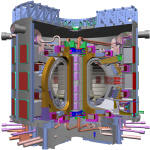
ITER's Tokamak

The most advanced approach to fusion involves
using magnetic fields to confine the deuterium
–tritium plasma. This is the route to be taken by
International Thermonuclear Experimental
Reactor (ITER), which will build a fusion reactor
at Cadarache in the south of France [ITER is an
international coallition among China, the European
Union (EU), Japan, Russia, South Korea and the
US]. The project will cost $10 billion to build and
run. ITER will use magnetic fields generated by
superconducting coils to confine a plasma of
deuterium and tritium in a donut-shaped chamber
called a Tokamak. The plasma will be heated to a temperature of 100
million degrees so that the deuterium and tritium nuclei can overcome
their mutual repulsion and undergo nuclear fusion.