.comment-link {margin-left:.6em;}

2Physics

2Physics Quote:
"Many of the molecules found by ROSINA DFMS in the coma of comet 67P are compatible with the idea that comets delivered key molecules for prebiotic chemistry throughout the solar system and in particular to the early Earth increasing drastically the concentration of life-related chemicals by impact on a closed water body. The fact that glycine was most probably formed on dust grains in the presolar stage also makes these molecules somehow universal, which means that what happened in the solar system could probably happen elsewhere in the Universe."
-- Kathrin Altwegg and the ROSINA Team

(Read Full Article: "Glycine, an Amino Acid and Other Prebiotic Molecules in Comet 67P/Churyumov-Gerasimenko"
)

Sunday, March 26, 2006

We are taking a break

We regret that due to unavoidable reasons, we need to take a break. We'll not have our regular postings in next two weeks. Regular postings will resume on April 10th. In the mean-time, you may go through our past postings on various topics of interest. We suggest that you use the search box on top to search for past postings on topics of your interest (e.g. 'Einstein', 'Fusion', 'Nobel Prize', etc...)


Thursday, March 23, 2006

Radioactive Detector

Silicon chip built with 16 tiny gamma ray detectors may help nuclear inspectors improve analysis of plutonium and other radioactive materials. Each detector is one millimeter square.
[photo courtsey: NIST]

Emissions from radioactive materials such as uranium or plutonium provide unique signatures that, if accurately measured, can indicate the age and enrichment of the material and sometimes its intended purpose or origin.

Scientists at the Commerce Department’s National Institute of Standards and Technology (NIST) have designed and demonstrated the world’s most accurate gamma ray detector, which is expected to be useful eventually in verifying inventories of nuclear materials and detecting radioactive contamination in the environment.

The tiny prototype detector, described last week at the American Physical Society national meeting in Baltimore, can pinpoint gamma ray emission signatures of specific atoms with 10 times the precision of the best conventional sensors used to examine stockpiles of nuclear materials. The NIST tests, performed with different forms of plutonium at Los Alamos National Laboratory, also show the prototype greatly clarifies the complex X-ray and gamma-ray emissions profile of plutonium.

The 1-square-millimeter (mm) prototype collects only a small amount of radiation, but NIST and Los Alamos researchers are collaborating to make a 100-sensor array that could be deployed in the field, perhaps mounted on a cart or in a vehicle.


Thursday, March 16, 2006

Efimov State Observed

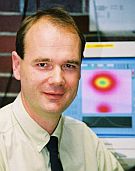
Rudolf Grimm

A Group of 10 Physicists led by Rudolf Grimm at the University of Innsbruck in Austria reported that they've been successful in converting three normal atoms into a special new state of matter called 'Efimov Quantum state' after the Russian scientist Vitali Efimov who proposed this in 1970. Efimov found a remarkable and counterintuitive solution to the notoriously difficult quantum-mechanical three-body problem, which concluded that 3 interacting particles can form a loosely bound system even if the 2-particle attraction is too weak to allow for the binding of a pair.

In order to prove that such a state can exist, experiments were conducted at Grimm's Laboratory on cesium atoms. There, for the first time, physicists were able to observe the Efimov state in a vacuum chamber at the ultra-cold temperature of a billionth of a degree above absolute zero, or minus 459.6 degrees Fahrenheit. Two of the three atoms repel one another in close proximity, but when you put three of them together, it turns out that they attract and form this new quantum state.

Efimov's result was a landmark in theoretical few-body physics, but until now these exotic states had not been demonstrated experimentally. Now that has been achieved, this may open up a new research specialty devoted to understanding the quantum mechanical behavior of just a few interacting particles.

The development is detailed in the March 16 issue of the journal Nature. If you are a Physicist, you may like to visit the website of Prof. Cheng Chin (University of Chicago) who is a member of the group that conducted this experiment.

Labels:


Sunday, March 12, 2006

Photon-Photon Scattering

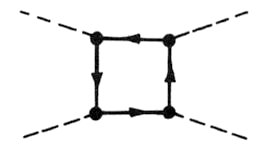
Vacuum is 'a space absolutely devoid of matter'. But according to Quantum ElectroDynamics (QED), particles can still be created in this emptiness of vacuum through light-light interactions. This property follows directly from the quantum nature of the sub-atomic world, to be specific, from the Heisenberg Uncertainty Principle which states that the uncertainty in the position of a particle and the uncertainty of the momentum of a particle are related. A consequence of this principle is that even though there is nothing in the vacuum (no matter or radiation at all), there is still an uncertainty in the amount of energy which can be contained in the vacuum. On average, the energy is constant, however, there is always a slight uncertainty in the energy, which may allow a nonzero energy to exist for short intervals of time. Because of the equivalence between matter and energy, these small energy fluctuations can produce matter (particles) which exists for a short time and then disappears.

In a paper entitled "Using High-Power Lasers for Detection of Elastic Photon-Photon Scattering" published in March 3 issue of Physical Review Letters (Vol.96), Physicists from Umeå University, in Umeå, Sweden, and the Rutherford Appleton Lab, England, propose an experiment to explore the vacuum by aiming three powerful laser streams at each other in 3-dimensional space of the Laboratory (This is important because such proposals mooted earlier had the beams all in a single plane). These three beams will merge to produce a fourth stream with a wavelength shorter than any of the input beams.

The actual experiment is planned to be carried out over the next year at the Rutherford Appleton Lab near Didcot, England. By carefully polarizing the incoming light beams, the number of photons in the output beam can be controlled. This would be an important tool for investigating the parameter space of such a complex experiment, thus providing valuable information about the interactions that took place in the vacuum.

Besides providing good insight into QED itself, this experiment would also be used for testing theories that propose the existence of minor departures from Lorentz invariance which is an important proposition in special relativity that there is no preferred frame of reference. Light-light interactions may also be used to explore various hypotheses related to dark energy that is a hot topic of cosmology nowadays and may provide some clue about the rate and nature of the expansion of the universe.

Labels: , ,


Wednesday, March 01, 2006

Owen Chamberlain (1920-2006)


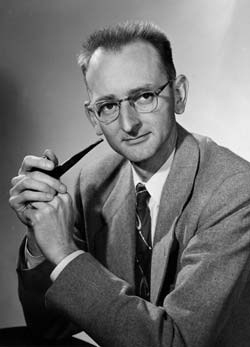
Owen Chamberlain, 1950s (photo courtesy: Lawrence Berkeley National Laboratory)

Nobel Laureate Physicist Owen Chamberlain died yesterday at the age of 85 in his Berkeley home. Owen was a Professor Emeritus of physics at University of California, Berkeley. Chamberlain died quietly in bed from complications of Parkinson's disease, which had plagued him for many years.

He and fellow UC Berkeley physicist Emilio Segrè, both researchers at the former Radiation Laboratory that is now Lawrence Berkeley National Laboratory won the Nobel Prize in Physics in 1959 for their discovery of the antiproton, the antimatter equivalent and negatively-charged mirror image of the proton. This previously postulated subatomic particle was the second antiparticle to be discovered and led directly to the discovery of many additional antiparticles.

Chamberlain worked on the U.S. atom bomb project from 1942 to 1946. He was present at the first atomic bomb test at Alamogordo, New Mexico, in 1945, losing a $5 bet that it would not explode.

Later, while completing his Ph.D. at the University of Chicago, he worked at Argonne National Laboratory, in Illinois. In 1948 he joined the faculty of the University of California at Berkeley, where he became a full professor in 1958. There he conducted research on alpha particle decay, neutron diffraction in liquids, and high-energy nuclear particle reactions.

His proton- and neutron-scattering experiments were conducted with the 184-inch cyclotron at the Radiation Laboratory on the hill above the campus, while his and Segrè's experiments with the antiproton were conducted with the UC Berkeley Bevatron, at the time the largest "atom smasher" in the world. Using it, Chamberlain achieved the first triple-scattering experiment with polarized protons. He and Segrè used the bevatron to produce antiprotons in 1955.

Although he retired in 1989, Chamberlain continued to attend weekly departmental colloquia at Berkeley, including one just last week.

Labels: ,